Arm Health


A decorated prep & collegiate athlete, Gunnar Hoglund, struggled to find his footing in professional baseball due to a Tommy John Surgery shortly before the 2021 MLB Draft. Out of high school Gunnar was a first round draft pick but chose to attend the University of Mississippi. After breezing through 3 straight years in college at Ole Miss it was expected he would continue this upward success through the professional baseball ranks. As mentioned though the road to success coming off of Tommy John Surgery was a long one for him. Once healthy, Gunnar found himself having to reset his focus on the aspects he felt hadn’t quite returned to shape. Fastball velocity, overall health, and sustaining consistent ball flight were all top of mind going into the 2023 winter off-season. 

At KP, ahead of the off-season, our staff dove into opening up what made Gunnar successful in the past and began to devise how we could establish a winter roadmap that would help Gunnar return to form, ready to compete in 2024. As the title obviously states, he had a great year. Here is how we set up his off-season to lay the foundation for this success…


Workload

Since the draft Gunnar had been through different rehab protocols, a trade and a flurry of attempts to keep his return to play pace slowed in hopes of protecting him. The truth though? All this effort to limit throwing intensity and limit outing length once he was deemed healthy really only hindered his ability to create the necessary adaptations to the load he would be facing in a regular season schedule. Our first priority this off-season was to assure Gunnar would be built up to handle the 2024 season. 

We knew that if Gunnar pitched well this year he would have a chance to start the year in AA. Looking back over our historical data that meant that with a throwing program built for him on a 5 day rotation he would need to reach at least a 15 throwing fitness by spring training. 

We started in November and built him up to just that before he left for spring training. Here is an example throwing program plan we used for him…


Stuff 

To begin the 2023 off-season we needed to look back and evaluate what potentially needed to improve in Gunnar’s arsenal. In College he predominately threw a 4 seam-fastball (61%), slider (31%) and a changeup (9%). 

It’s important to note when evaluating any arm that the level of competition can sometimes dictate a usage change in a pitcher’s arsenal. With Gunnar returning from Tommy John but now competing at a much higher talent level, we did have to ask if the level of play was contributing to a lower level of success for him. 

The other question to ask was surrounding Gunnar’s actual health. After a long time in the rehab process athletes can often struggle to return due to things aside from just the arm. Atrophy is real and when athletes are focused on arm health, sometimes they forget about their overall development in the weight room. 

Looking at available data. We wanted to see areas where we might find major changes in Gunnars historical data. We asked the question, did he actually return to the player he was in 2021 or had he not?

If we could first identify this then we could establish a plan to get those metrics to return. Beyond this we would then have to plan for ways to optimize Gunnars development further to give him the best chance at finding success once again in 2024. 

Upon a deep dive into Gunnars data the first obvious area of change for Gunnar was in Fastball velocity. In 2021, pre-injury, Gunnar had an average FB velocity of 92.5. Post surgery, this declined to roughly 90mph for both the 2022 and 2023 seasons. 

FB Velocity

FB Velo (by year)
2021 (College): 92.5
2022 (Pro): 89.8
2023 (Pro): 90.8
2024 (Pro): 92.2


Fastball velocity was an obvious problem but for us indicated that he might not have been built up enough or lacked just the general strength he once had. Many would jump to conclusions here and want to make this a mechanical problem or feel the need to push a velocity program. There was no need for a velocity program here and his biomechanics reports from season didn’t indicate a need for anything but some minor changes to his plyocare routine. We had confidence that with a quality workload based throwing progression and a good off-season pushing him in the weight room that this velocity would return. 

After 4 months going back to the basics of managing his throwing workload and developing his strength, it’s obvious to see the velocity did return in 2024. A major win to begin his return to success in season. 

So velocity was back and this meant the fastball was in a much better place for the upcoming season. Our staff had to decide what else we would want to improve to give Gunnar the best chance at a breakout year in 2024.

Enter the less efficient change up… 

At the onset of the winter we approached Gunnar with some ideas on his change up. We started messing around with the idea of adding depth and he was all for it! 

Now depth could mean a lot of things, possibly creating a splitter instead of a change up, it could also mean possibly creating a SSW changeup, or we could focus on a pitch that just completely messed with efficiency and lowered the magnus force of the pitch.

With Gunnar finding comfort and repeatability of the less efficient change up, we pushed forward to implementing into his arsenal. We utilized a 2-seam changeup grip that added a spike to the middle finger. We spike the middle finger to get dominance out of the ring finger which essentially pulls the lateral seam down (sideways) and creates a more horizontal axis to the pitch. Since the pitch interacts with the air less efficiently, it utilizes less spin and therefore, has more vertical drop than a typical changeup. The results form this change were spectacular this year:


CH metrics (by year):

2023
82.4 mph
12.6 vb
1:40 tilt
0.7 HAA
-7.4 VAA
2075 rpm
 
2024
83.5 mph
4.2 vb
2:24 tilt
-1.7 HAA
-7.9 VAA
1660 rpm
 

Major improvements across the board on the CH marked an important change in both FB velo and CH shape to close the winter off-season. The question, after the off-season’s improvements, would be surrounding the actual impact these changes would make on his success. Let’s look at some of his data from 2023 to 2024 in order to better understand the impacts of these changes. 


2023:
6.05 ERA
1.3 WHIP
9.9 H/9
6.8 SO/9
 
2024: 
3.20 ERA
1.034 WHIP
6.9 H/9
8.3 SO/9
 
ERA: Down from 2023
WHIP: Down from 2023
Hits Per 9: Down from 2023
Strike Outs: Up from 2023

Massive changes! What about his Fastball and Changeup though? Did they actually improve compared to the previous year? For this we will use xWOBA to measure improvements 2023 to 2024…


Fastball
2023 LHH: .359 RHH: .329
2024 LHH: .336 RHH: .268
 
Change Up
2023 LHH: .329 RHH: .392
2024 LHH: .240 RHH: .209


We’ve now explained the impacts of our off-season work surrounding workload and stuff. Let’s talk about the last major piece of our plan… Gunnars strength. 


Strength

What does it mean to get stronger? Is it adding weight to your deadlift? Is it just being able to jump higher? The industry is full of arbitrary measures of strength but strength is something developed over time. It is something that requires the consistency of an athlete and the proper progression of a well built program. At KP we use our “KP Lifting Score” to govern and assure strength development. 

Uniquely our score accounts for the exercise load, individual player body type, the movement of the exercise selected and tempo. 

Our focus for Gunnar was to increase his “KP Strength Score” and push him physically to get as high as he could on our scoring before the end of the off-season. Starting around a 40 Gunnar moved all the way to a 71 “KP Strength Score” over 11 weeks. This was a substantial progression and marked his overall strength improvement during this period. 


Conclusion:

As shown above Gunnar’s off-season development paid off substantially in 2024. Even with the successes this year, competitors like Gunnar seem to never be content. As the ‘24 season concludes, we understand that we are going to have a conversation about what is next. This is where finding the 1% needed change and uniquely deploying a program to improve that 1% in the duration of the winter becomes an art.

It’s back to the drawing board. How do we continue trending towards the best version of Gunnar Hoglund? What is it going to take to reap these similar results at the big league level? Answering these questions and working with Gunnar to bring to light the answers is what makes this process so exciting and rewarding in the long run. How good can Gunnar Hoglund get? We are appreciative to be a part of the journey to find out. 


Want to get started training with KP? We offer both remote and in person training (Tampa FL). 
To get started with remote training: Click Here 
To get started with in person training: Click Here
 

Want more KP? Be sure to check us out on our social media channels…
Youtube: @KP3
Twitter: @Kinetic_Pro
Instagram: @KineticProPerformance

Introducing Our New Course: Winning With Workload

Workload management is one of the most important and often overlooked aspects of pitching. With the right approach, pitchers can enhance performance while reducing the risk of injury. Our newest course, Winning With Workload, is designed to help you understand and apply the principles of workload management.

This course dives deep into the science and practical application of managing throwing workloads. It covers everything from why traditional pitch counts aren’t enough to how fatigue plays a role in injuries. 

Here’s what you’ll find in the course:

  • Understanding Fatigue: Learn why fatigue is the number one factor behind throwing injuries.

  • Assessing Workload: Discover how to track and calculate daily throwing workloads, accounting for both game-day pitches and all the other throws that add up.

  • Progressive Programming: Explore multiple course modules designed to build throwing fitness while avoiding overuse.

  • Dynamic Adjustments: Understand how to adjust workloads in real-time based on a pitcher’s readiness, helping to optimize performance while reducing injury risk.

  • And More: Winning With Workload includes practical units explaining how to use our free player app to manage workload, discussions with influencers in the game around the topic and so much more… 


Winning With Workload is now part of the KP3 Community.

What Is the KP3 Community? The KP3 Community is a space where players, coaches and parents come together to explore advanced baseball topics like biomechanics, workload management, strength and other player development topics. Here’s what you can expect:

  • New Content Regularly: Access new courses, articles, and resources designed to keep you learning and improving.

  • Expert Insights: Gain knowledge from some of the top minds in baseball and sports science.

  • A Community of Learners: Connect with others who share your passion for the game.


What does KP3 Community cost to join?

Payment options for KP3 Community include:


Annual Access: $99.99/year

Lifetime Access: $299


Both options include unlimited access to courses “Winning With Workload”, “The Future Of Arm Care” and future course releases. 


Ready to Dive In?

If you’re ready to implement and understand workload management, our course Winning With Workload is the perfect place to start. Join the KP3 Community and see how throwing workload can help you stay healthy/ perform at your best.

Dive deep into our other KP3 Community courses and learn about player development topics that are pushing the front line within the game today! 


Get Started With KP3 Community


The UCL Graft Journey: Understanding Tommy John Surgery’s Critical Timelines

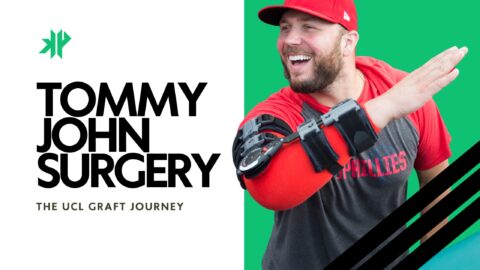
Have you ever seen someone walking around with one of those robot looking braces on their arm only to find out they have just had Tommy John Surgery? You might have wondered why pitchers need to wear such a device and what exactly that device is allowing the athlete to do. In the context of recovery from Tommy John there are so many questions parents and recipients have along these lines. 

You’ve likely heard the term “Tommy John Surgery” (UCL Reconstruction) tossed around, and probably, the even more common refrain: “It’s a year-long recovery.” But what exactly is happening during that year? Why does it take so long? And, most critically, when does that new ligament – the graft – truly “take” or “heal”? As someone who’s delved into the intricacies of Tommy John Surgery, I can tell you that understanding the biology behind the timeline is key to patience and successful rehabilitation. It’s not just about getting clearance from your surgeon; it’s about respecting the incredible, complex process your body goes through to rebuild itself.

Step 1: The Post Op Period (Fresh From Surgery)

Right after surgery, that new UCL graft is at its most vulnerable. Like, extremely vulnerable. We’re talking about a piece of tendon (often from your forearm or hamstring) that’s been surgically threaded through bone tunnels and anchored with sutures. While those sutures and bone anchors provide immediate mechanical stability, the graft itself is essentially a dead piece of tissue awaiting support to come back to life. Think about it like this, the blood supply has been severed, the cells within the tendon are starting to die off, and your body hasn’t yet recognized it as “part of the team.” It’s an inert structure, held in place by surgical magic, but lacking its own biological life support system. This is why you’re in a brace, restricted to specific flexion and extension limits, and why your physical therapist gives you the “death stare” if you even think about doing something stupid. “The initial period following UCL reconstruction is characterized by the graft’s avascularity and cellular necrosis, making it highly susceptible to mechanical failure without adequate protection,” notes a foundational text on sports medicine (Andrews & Wilk, 2012). This isn’t just theory; it’s why pushing it too early is a one-way ticket back to the operating table.

So, how does a dead piece of tendon become a strong, living ligament? This incredible process is called ligamentization. It’s a biological marvel that transforms the graft over many months. The first phase, spanning roughly the first six weeks, is dominated by inflammation and revascularization. Your body, ever the diligent repair crew, immediately sends inflammatory cells to the graft site. This is quickly followed by the growth of new blood vessels that slowly infiltrate the graft—a process known as revascularization. Think of it like a new road network being built into a previously isolated area. Crucially, during this phase, the graft is actually getting weaker before it gets stronger, as the initial cells die off and the new ones haven’t fully moved in and set up shop (Ahmad et al., 2004). This fragility is why strict protection of a brace and caution from the athlete is paramount.


Step 2: The Intermediate Period

As we move into the intermediate period, from about six weeks to six months, the elbow transitions into the stage of cellular proliferation and collagen deposition. By about six weeks post-op, the surgical fixation points (sutures, bone tunnels) are generally considered stable enough to allow for increased range of motion and discontinuation of the brace for daily activities. This is the first major psychological hurdle where you start to feel a little more “normal.” However, the major biological shift is underway: specialized cells called fibroblasts migrate into the graft, laying down new, haphazardly organized collagen fibers. Imagine a tangled mess of spaghetti. But they’re there, forming the early scaffolding of your new ligament. The graft is slowly gaining intrinsic biological strength, which is why it becomes less vulnerable, but it remains far from robust enough for high-velocity stress.

The long haul begins in the subsequent phase: remodeling and maturation, spanning from six months out to eighteen months or even longer. This is where the magic truly happens. The disorganized collagen fibers begin to align themselves along the lines of stress, becoming stronger and more organized. The graft tissue gradually transforms, both microscopically and macroscopically, to finally resemble a native ligament. It becomes denser, stiffer, and, crucially, capable of withstanding the incredible forces placed on the elbow during overhead throwing. “The complete biological maturation of the graft to a tissue structurally comparable to native UCL has been documented to extend beyond 12 months, often up to 18 months or more,” according to studies on graft histology (Sauers et al., 2017).


Step 3: The Return To Throw Period

To directly answer the burning question of “how  vulnerable is the graft at this point? The graft is no longer critically vulnerable and is structurally sound enough to begin a controlled, low-stress activity around four to six months post-op. This is not arbitrary; it is the time point where the graft has undergone sufficient ligamentization to tolerate the controlled, progressive stresses of a return-to-throwing program. The new collagen is forming, and the tissue has gained enough tensile strength to manage the low-intensity, gradual build-up of throwing mechanics. The final functional test comes at nine to twelve months, where athletes begin returning to competitive pitching. While the graft isn’t fully mature, it’s considered functionally strong enough to withstand increasing valgus stress. However, for the graft to achieve its true peak strength and maximum durability, the process extends beyond the year mark, often requiring up to eighteen months of careful, progressive loading to account for the final stages of collagen remodeling and alignment. This is why continued strength development AND A PROPERLY PROGRESSED THROWING PROGRAM are so critical. Finding the right people and programs for both could mean the difference in a successful return vs one to which you struggle to regain your footing at the higher levels. 


Conclusion

Dr. Ahmad and his team pointed out that only 28% of athletes return to who they once were on the field 3 years after Tommy John Surgery. Where we previously defined the surgery as massively successful, this paper identifies the difference in just throwing a pitch in a game again after TJ to reaching the same standard of performance as pre surgery.

The journey of a UCL graft from a harvested tendon to a fully integrated, functional ligament is a testament to your body’s healing capabilities. But it’s not a fast process. The initial fear of re-testing the UCL right out of surgery is completely valid because the graft is biologically compromised and reliant solely on mechanical fixation. As time progresses, through the incredible process of ligamentization, your graft gains its own blood supply, new cells, and organized collagen fibers, making it progressively less vulnerable. But “less vulnerable” never means “invincible,” especially in the high-stress environment of overhead athletics or pitching. Understanding these biological timelines helps us appreciate the importance of adherence to rehab protocols, patience, and realistic expectations.

As the research study referenced here indicates, it’s not just about getting back on the field… it’s about getting back better and winning your future. Understand the timelines, define success in the process and get back to performing at your best. That should be our goals. 


Want to get started training with KP?
Check out our in person training or our PT services located in Tampa FL.

Want more KP? Be sure to check us out on our social media channels…
Youtube: @KP3
Twitter: @Kinetic_Pro
Instagram: @KineticProPerformance


X

Lets Climb! Click here for quick links and support.